Front Line Safety Establishes New Distribution Center in Kansas City, Missouri

Facility to create 21 new jobs and strengthen Kansas City’s position as a leading industrial hub

KANSAS CITY, Mo. (June 2, 2026)Front Line Safety today announced plans to establish a new safety and first aid solutions distribution center in Kansas City, Missouri, investing $1.7 million and creating 21 new jobs. The project is expected to generate $6.1 million in new annual payroll.

“Front Line Safety’s decision to establish a new distribution center in Kansas City is another strong signal that Missouri continues to be a destination for companies focused on growth, innovation and service,” said Governor Mike Kehoe. “This investment strengthens critical supply chains for safety and first aid solutions while creating new opportunities for Missourians and supporting the continued momentum of the Kansas City region. We are proud to welcome Front Line Safety to Missouri and look forward to their long-term success in our state.”

“We are excited to expand our operations with a new warehouse and distribution center in Kansas City, Missouri,” said Joe Bratter, chairman & CEO of Front Line Safety. “After an extensive nationwide search, Kansas City emerged as the clear choice for our next phase of growth. The region’s unmatched multimodal infrastructure, strong and reliable workforce, and central geographic location create an ideal environment for a modern distribution operation that can efficiently serve our customers.”

The 113,000-square-foot facility, secured with local real estate firm CBRE, will support Front Line Safety’s continued growth and expand the company’s ability to efficiently serve customers throughout the Midwest and across North America.

“Kansas City continues to attract companies that recognize the value of our workforce, infrastructure and strategic location,” said Mario Vasquez, City Manager of Kansas City, Missouri. “Front Line Safety’s investment demonstrates the confidence businesses have in our community and our ability to support long-term growth.”

Front Line Safety joins a well-established and highly connected distribution and logistics ecosystem in the region, where robust multimodal infrastructure enables distributors to reach 90% of the contiguous U.S. within two days or less. Combined with its central U.S. location and strong pipeline of skilled workers, the Kansas City region provides manufacturing, distribution and supply chain companies with unmatched connectivity and operational efficiency.

“Front Line Safety’s expansion into Missouri highlights the state’s strength as a logistics hub,” said Subash Alias, CEO of Missouri Partnership. “With our central location, skilled workforce and strong transportation network, Missouri continues to attract companies that keep critical industries moving safely and efficiently.”

“As a top 15 U.S. industrial market, Kansas City continues to stand out as one of North America’s most strategic logistics hubs, offering companies unmatched access to customers, suppliers and major transportation networks,” said Chris Gutierrez, president of KC SmartPort. “Front Line Safety’s investment reinforces the region’s strength as a premier location for distribution and supply chain operations, and we’re excited to support the company’s continued growth in the Kansas City market.”

The facility is expected to officially open in July 2026.

About Front Line Safety

For more than 30 years, Front Line Safety has provided workplace safety, first aid and compliance solutions for businesses across North America. The company specializes in customized safety programs, first aid and PPE solutions, centralized ordering systems and compliance support designed to help organizations create safer and more efficient workplaces. Front Line Safety offers more than 3,000 safety products and services tailored to a range of multi-unit businesses, including grocery stores, restaurant chains, hospitality operators and manufacturing companies located across the United States. | flsafety.com

About KC SmartPort

An affiliate of the Kansas City Area Development Council, KC SmartPort is the authority on industrial operations in the 18-county, two-state Kansas City region. The nonprofit economic development organization promotes and enhances the Kansas City region’s status as a leading North American manufacturing and logistics hub, attracting industrial investment into the market. In the last five years, KC SmartPort has attracted projects representing $6.9 billion in capital investment, over 9,400 jobs and 14 million square feet of space to the KC region. | OneKC.org/KCSmartPort

###

Nebius Breaks Ground on Gigawatt-Scale AI Factory in Independence, Missouri

City leaders and local stakeholders help launch construction of multi-building campus that supports 1,000+ jobs, sizable tax revenues, and area education programs

INDEPENDENCE, MO May 12, 2026 — Nebius (Nasdaq: NBIS), the AI cloud company, today broke ground on its flagship AI factory campus in Independence, Missouri – the company’s first gigawatt-scale digital infrastructure project in the U.S.

The ceremony brought together state and local leaders, economic development partners, community members and company representatives to mark the start of construction of the multi-building AI factory on approximately 400 acres in eastern Independence.  

Nebius already operates in the Kansas City area and sees the Independence AI factory as a critical next step in its long-term growth in the U.S.

“Missouri continues to lead in innovation, infrastructure, and investment, and this facility in Independence is another example of that momentum in action,” said Governor Mike Kehoe. “This investment from Nebius strengthens Missouri’s position as a national leader in digital infrastructure, while creating quality jobs, supporting local schools and businesses, and generating long-term opportunity. We are proud to support investments that keep Missouri competitive and moving forward.”

“Projects like this are built for the long term, and we are committed to developing this facility in a way that directly benefits Independence,” said John Boynton, Nebius Board Chairman. “We want to create lasting opportunities, act as a good partner with the community, and set a standard for developing AI and digital infrastructure responsibly.”

Construction of the first phase of the AI factory is now underway. In both the construction and operation phases, Nebius has put in place intentional design measures to minimize impact at a local level, including by minimizing water use, containing noise and light, and protecting ratepayers.

Creating approximately 1,200 construction jobs – overwhelmingly drawn from local union building trades – and 130 permanent high-tech positions at full operation, Nebius’ Independence investment is also expected to generate $650 million in tax payments to local school districts and taxing jurisdictions over the next 20 years. 

Nebius is committed to transparent operations and sustained community engagement. As part of this, the company has established a community benefits plan focused on education and local investment, and has already begun to put this into practice, including a recent donation to eliminate school meal debt at Independence and Ft. Osage School Districts and an initial agreement with Metropolitan Community College focused on AI literacy and workforce development.

More information about the Nebius AI factory in Independence, Missouri, can be found at nebius-independencemo.com.

Here’s what community, business, and education leaders are saying about Nebius’ collaborative, partnership-focused investment approach:

  • Valerie Byrnes, President of the Independence Chamber of Commerce and Economic Development Partnership: “This project is a powerful catalyst for sustained economic growth in Independence. This is a pivotal project that elevates a city’s trajectory—attracting new industries, driving infrastructure investment, and creating momentum that will shape our economy for decades to come.”
  • Michelle Hataway, Director of the Missouri Department of Economic Development: “Nebius’ decision to expand in Independence is another strong signal that Missouri is competing and winning in the technology and innovation economy. This billion-dollar-investment and creation of new jobs will bring new opportunities to the region while strengthening the state’s growing reputation as a destination for high-tech industry and forward-looking investment.”
  • Subash Alias, CEO of Missouri Partnership: “This project highlights the extraordinary pace of growth in the AI industry – and why Missouri is the right place for that growth. With our central location, robust infrastructure, and ability to deliver power at scale, Missouri offers a compelling environment for next-generation technology investment, and Nebius’ decision reinforces our strength as a global competitor.”
  • Tim Cowden, President and CEO of the Kansas City Area Development Council: “The Kansas City region continues to stand out as a top destination for global technology investment. Nebius’ decision to choose Independence underscores the strength of our infrastructure, our talent pipeline and a highly collaborative, business-focused environment that helps companies scale and succeed.”
  • Ned Finkle, NVIDIA Vice President of External Affairs: “Artificial intelligence is driving the largest infrastructure buildout in history — and that buildout must be rooted here in the United States. This Nebius campus will create thousands of jobs, strengthen American supply chains, and build the AI factories that will power the next era of computing. NVIDIA is proud to stand with Nebius and the State of Missouri as we build the future of AI in American communities, with American workers.”
  • Dr. Cynthia Grant, Deputy Superintendent of Instructional Services, Independence School District: “The Nebius AI factory represents a once-in-a-generation economic opportunity for our community. For our district, it is projected to generate more than $463 million over the next 20 years, providing long-term stability and allowing us to better support our students, staff, and schools.”
  • Dr. Kimberly Beatty, Chancellor, Metropolitan Community College: “The addition of Nebius to the Kansas City region will add value to the economic development ecosystem through their contribution to the community and K-16 education system. For MCC and most education entities, the ability to learn and partner with an AI expert has tremendous return on investment as we continue to serve our communities and students.”
  • Chris Wilson, CEO of ARCO National Construction: “Projects of this scale require deep coordination and technical expertise. We are proud to partner with Nebius to deliver a facility of this complexity and bring it online in Independence.”

About Nebius

Nebius, the AI cloud company, is building the full-stack platform for developers and companies to take charge of their AI future — from data and model training to production deployment. Founded on deep in-house technological expertise and operating at scale with a rapidly expanding global footprint, Nebius serves startups and enterprises building AI products, agents, and services worldwide. Nebius is listed on Nasdaq (NASDAQ: NBIS) and headquartered in Amsterdam. For more information, please visit www.nebius.com

About Missouri Partnership

Missouri Partnership is a public-private economic development organization that attracts new jobs and investment to Missouri by promoting the state’s competitive business strengths. Since 2008, Missouri Partnership has led and supported economic development projects in collaboration with partners across the state, generating thousands of jobs and billions in new capital investment. Learn more about our recent projects.

Contacts

For media: media@nebius.com

For Independence residents: IndependenceMO@nebius.com

Beale Infrastructure Announces $250,000 in Community Investments for De Soto, Kansas 

DE SOTO, Kan. – May 11, 2026 – Beale Infrastructure has announced it will launch a $250,000 community investment fund for its $3B De Soto Data center campus that will benefit local and regional nonprofits. Beale will work with local partners over the next year to identify additional grant projects. 

Beale is solidifying its commitment to the De Soto community through a series of local initiatives designed to enhance the quality of life for residents today and into the future. Cornerstone partnerships include: 

  • The De Soto Kansas Food Pantry
  • The USD232 Education Foundation 
  • City of De Soto initiatives, including:
    • Lighting the downtown De Soto water tower near 83rd St. and Wea St. 
    • Revitalizing local recreation by sponsoring the irrigation system for two new ballfields at Riverfest Park
  • De Soto Days
  • Additional grant projects identified by local partners 

Beale is prioritizing supporting projects that benefit the needs and well-being of its neighbors, and we are proud to support local programs to help ensure the community’s traditions continue to thrive. 

“This significant investment in our community, both in terms of economic impact and community support, speaks to Beale’s commitment to being a true community partner,”said Rick Walker, Mayor of De Soto. “Their support for local organizations and initiatives will have a real impact, and we appreciate their investment in De Soto’s future, and we look forward to our community having the opportunity to learn more at the June public event.”

The first phase of the data center project is expected to generate significant economic impacts with more than $150 million in local and county revenue over 25 years. Of that, the De Soto Unified School District 232 will receive more than $75 million. In addition, the project will create local workforce opportunities for thousands of construction workers and at least 50 full-time, on-site jobs once operational, with additional positions added in future phases. 

The project reflects Beale’s responsible development model, which emphasizes disciplined site selection aligned with local land use planning, proactive engagement and long-term partnership with local communities, as well as direct investment to strengthen area infrastructure and the local workforce. All major project infrastructure – including power delivery, water systems and site improvements – will be privately funded by Beale, ensuring costs are not passed on to residents and ratepayers. Beale is committed to paying its own way and providing the infrastructure that we all depend on. 

“Beale’s investment is a win for DeSoto and Kansas,” said David Campbell, chairman and chief executive officer at Evergy. “Evergy has established rates that ensure new large energy users like Beale pay prices that cover the cost to serve them plus bring benefit to all our customers. Beale’s agreement to long-term energy contracts and to cover the costs for infrastructure that solely serves its facility demonstrates its commitment to the community.” 

“Kansas City’s growth in the digital infrastructure sector continues to accelerate, and projects like this reinforce the region’s position as a destination for forward-looking investment,”said Tim Cowden, president and CEO of the Kansas City Area Development Council. “Beale is an excellent company with impeccable credentials in the global technology community. The company’s commitment to De Soto and KC as a whole further ensures this growth translates into real, lasting benefits for residents all across the region.”

“Beale’s significant support for the City of De Soto is certainly worth celebrating,”De Soto Chamber & Economic Development Council President Tim Holverson. “It says a lot about Beale Infrastructure that this historic investment in our digital infrastructure is accompanied by impactful investment in the surrounding community. It is the beginning of a long-term partnership that is truly Community First.”

Beale is also actively engaged in conversations with Johnson County Community College (JCCC)to build out enhanced workforce and educational partnerships. In aligning with JCCC, Beale aims to create a sustainable pipeline for high-tech careers, while fostering a local robust talent pool that will drive De Soto’s growth into the future. 

“Our investment in De Soto goes far beyond the physical infrastructure. We are investing in the people, the educational pathways and the community fabric that will drive this region’s growth in the evolving digital economy for decades to come,”said Tony Burkart, Senior Vice President, Public Policy & Public Affairs at Beale. “We are committed to being a catalyst for growth, beyond the four corners of our site. We look forward to growing alongside our neighbors and contributing to the enduring prosperity of De Soto for future generations.” 

Beale is planning for a community-focused event in June; more information will be shared on the project page, which can be found at https://bealeinfra.com/de-soto-kansas/.

### 

About Beale Infrastructure 

Beale Infrastructure develops digital infrastructure for the world’s leading technology companies, partnering closely with customers, communities and utilities to enable innovative data center solutions with sustainable long-term impact. For more information about Beale, please visit www.bealeinfra.com

For media inquiries, contact: media@bealeinfra.com 

Metrobloks Selects Liberty, Missouri, for $1.4 Billion Data Center Investment 

Digital infrastructure leader to deliver high-wage tech jobs and power next-generation connectivity in Kansas City region

Metrobloks today announced plans to invest $1.4 billion in Liberty, Missouri, with a state-of-the-art, high-density data center campus, encompassing 568,800-square-feet of space across three buildings. 

“Metrobloks is proud to expand in Liberty, where we found the ideal combination of infrastructure, talent and community partnership to support our next phase of growth,” said Ernest Popescu, CEO of Metrobloks. “This investment reflects our confidence in the Liberty area as a rising digital economy and innovation hub, and we look forward to building a facility here in the Kansas City region that delivers long-term value for both our customers and the community.” 

Metrobloks is known for delivering high-performance data centers in strategic U.S. markets, helping companies scale cloud and AI for last mile data delivery for latency sensitive applications. The company’s Liberty campus will leverage the Kansas City region’s central location, robust fiber network and reliable, cost-effective power — providing low-latency connectivity and the infrastructure needed to support rapidly expanding digital demand. 

“Metrobloks’ investment is another powerful signal that the Kansas City region is well-positioned for the next phase of the digital economy,” said Tim Cowden, president and CEO of the Kansas City Area Development Council. “Data infrastructure powers every aspect of modern life. With decisions like Metrobloks’, KC will remain at the nexus of our most critical sectors, including healthcare, fintech and defense, as the region continues to serve as a hub for this revolutionary economic transition.”

The new investment brings increased tax revenues and at least 30 jobs with an average annual wage of $95,649, as well as hundreds of construction jobs. Metrobloks’ data center features a very low water use design and low impact operations, with limited demands on schools, emergency services and municipal resources. 

The Kansas City Area Development Council was proud to partner with the following organizations in attracting Metrobloks to the KC region:

State of Missouri
Missouri Department of Economic Development
Missouri Partnership
City of Liberty, Missouri
Liberty Economic Development Corporation
Evergy
Spire
Spencer Fane

History of the KC Heart

How the heart became the symbol for KC.

Kansas City has been home to a number of celebrity artists, designers, performers and athletes. Check out some of our more notable homegrown celebrities.

The KC Heart may be known for its iconic appearance on Charlie Hustle T-shirts and its use in the new Parade of Hearts art campaign, but Kansas City’s love affair with the heart symbol actually began more than a century ago.

According to multiple sources, Halford Mackinder, a British geographer, coined the term heartland in 1904 to refer to the heart of the Eurasian landmass: a strategic center of industry, natural resources and power. The use of the term heartland to apply to the American Midwest became common sometime in the early 20th century, and Kansas City was one of the first Midwestern towns to embrace the idea of being located in the “heart” of America.

The heart soon became an ingrained part of Kansas City culture. Railroad workers wore KC Heart pins in the early 1900s to signify the town they called home. The symbol was later engraved in steel on light poles in the Country Club Plaza shopping district in the ’50s and ’60s.

And when the Kansas City Monarchs Negro Leagues baseball team donned the KC Heart patch on their sleeves, the team’s civic pride was on full display as they went on to achieve championship victory in 1942.

Inspired by the rich heritage of the heart, the Charlie Hustle brand began selling its signature KC Heart T-shirts in 2011. Since then, more than 1 million of the shirts have been worn by people across the globe, including major celebrities, and the heart is world-renowned as the calling card for the entire two-state region.


How to Engage Community in a NIMBY World

Guest Authored by Jeanine Jerkovic

No, you’re not imagining it: Anti-development and anti-growth sentiments are on the rise nationally. Whether it’s feelings of areas being ‘good as they are,’ overdevelopment concerns or just not trusting local government, 26% of Americans reported actively opposing a new development in a January 2025 Emerson College Polling survey. 

In the face of NIMBYism (Not in My Backyard), economic developers must master authentic community engagement, partnerships and public relations like never before. It’s time to rethink our approach and reenergize communities around the opportunities that come with local growth.

Rethinking NIMBYism

The environmental NIMBY resistance to nuclear power plants and landfills of the ‘50s and ‘60s is past. Today, the concerns are more far-reaching and the backyard is larger. 

  • A wider lens: Today’s NIMBY covers public health, social justice and impact on property values.
  • All about the Backyard: Opposition is not necessarily to the project, housing, retail or otherwise on principle as much as it is location-based.
  • Who benefits from growth: Community members may not feel a personal benefit to themselves or their community — only the developers’ interests.
  • More challenging than ever: As public concerns about growth become more organized and vocal, economic developers must rise to the occasion with bold, creative strategies, including persuasive communication.

Reframing the Conversation

Reframing development and growth can be a tall order, but getting the community invested in new housing and retail projects, showing up and participating, can balance out naysayers to shine light on the overall vision. Here’s how:

  • You have to care first: Consistently show residents, through actions, direct outreach and candid conversations that you care about them and are empathetic to their concerns. All opinions stem from people caring about their community.
  • Ease friction through open communication: Simplifying confusing project attraction processes turns support and participation into easier asks.
  • Listen up: Host public work sessions and forums to gauge community sentiment and empower them with information. Use tools, including social media, to shape narratives and counter resistance.
  • Leaders set the tone: Prep civic leaders with the facts – their visible actions and energy shape the way community members feel about development and growth. 

Reenergize your Community

Harnessing local energy and strategic engagement can turn big dreams into real progress. 

  • Identify a community’s rallying point: Identify a shared communal value to use as a foundation for framing the overall benefit to residents. 
  • Make the process enjoyable and inclusive: Invite residents to fall in love with the vision and contribute unique insights.
  • Activate the power of social media: Give residents tools to engage and champion efforts online. Spreading the long-term benefits to fearful neighbors from the mouths of those they trust the most: each other. 

Even anti-growth voices often stem from a desire for a better future. By listening and involving residents and voters, we can build communities ripe for growth — shaped and supported by the people who live there.

Jeanine Jerkovic is the Economic Development Director for Surprise, AZ, bringing new retail and employment opportunities to the community. Connect on LinkedIn.


Ready to turn community resistance into community momentum? The KCADC team and our partners are here to help you navigate local engagement with confidence and clarity. Contact us to learn more.

Lambda Doubles Down on Midwest Expansion, To Build AI Factory in Kansas City, MO

San Francisco, CA – October 28, 2025 – Lambda, the Superintelligence Cloud, today announced it is planning to transform an unoccupied 2009-built facility in Kansas City, Missouri, into a state-of-the-art AI Factory. 

This Kansas City deployment is part of Lambda’s mission to build the infrastructure backbone for the Superintelligence era. Under the agreement, Lambda is planning to develop and operate the facility as the sole tenant. The site is expected to launch in early 2026 with 24MW of capacity, and the potential to scale up to more than 100MW in the future.

“Missouri is proud to welcome Lambda as they create new, high-quality jobs and strengthen our state’s technology and innovation ecosystem,” said Governor Mike Kehoe. “Their decision to grow here demonstrates the confidence that leading companies have in our people, our infrastructure, and our pro-business environment. It’s been said that AI is the space race of our time, and we must win. Data centers are the future and critical to our continued ability to drive technological innovation, strengthen our economy, and safeguard our national security interests. Partnerships like this ensure Missouri remains at the forefront of America’s winning strategy.”

“Our Kansas City development perfectly embodies Lambda’s strategy: a prime location for our customers, an accelerated deployment timeline, and an unwavering commitment to on-time delivery,” said Ken Patchett, VP of Datacenter Infrastructure at Lambda. “We believe this success stems from completely rethinking how AI factories should be built and operated.”

Building big, shipping fast

When the facility launches in early 2026, it will initially feature more than 10,000 NVIDIA Blackwell Ultra GPUs—a footprint expected to double over time. The supercomputer is dedicated to a single Lambda customer for large-scale AI training and inference, under a multi-year agreement.

“Today in Kansas City, we are building the infrastructure to capitalize on AI’s boom,” said Mayor Quinton Lucas. “An investment of this scale in the Northland highlights our city’s strength in technology, innovation, and job creation, and brings an empty asset back to life through creative reuse.”

The project enables Lambda to repurpose unused power and transform a formerly advanced data center into an AI-ready, future-proofed facility.

“Choosing Kansas City, Missouri, for a next-generation AI data center sends a clear message: Missouri is the tech leader in the center of the country,” said Subash Alias, CEO of Missouri Partnership. “We applaud Lambda for building an AI factory in the heart of the U.S. This is a generational investment that will expand opportunity for Missourians and accelerate the digital economy.”

“This investment from Lambda showcases the Kansas City region’s ability to creatively reimagine assets and attract transformative investment,” said Tim Cowden, President and CEO, Kansas City Area Development Council. “Data centers are critical to powering the innovation economy, and Kansas City wields the strength of infrastructure, reliable power, and a deep IT talent pool that continues to draw leading technology companies to the region.”

“Lambda’s investment in the Kansas City area emphasizes our state’s growing strength in technology and innovation,” said Michelle Hataway, Director of the Department of Economic Development. “DED is proud to support future-focused projects like this that enhance our workforce, drive sustainable growth across the region, and create opportunities for Missourians to prosper.”

This project was made through many local partners in Kansas City including the State of Missouri, Missouri Dept. of Economic Development, Missouri Partnership, Kansas City Area Development Council (KCADC), Platte County EDC, City of Kansas City, Mo., Economic Development Corporation of Kansas City, Mo., Port KC, Evergy, Spire, Inc., KC Tech Council, Russell Construction, Henderson Engineers, U.S. Engineering, and Capital Electric.


About Lambda

Lambda, The Superintelligence Cloud, builds gigawatt-scale AI factories for training and inference. From prototyping to serving billions of users in production, we build the underlying infrastructure that powers AI. Lambda was founded in 2012 by published AI engineers.

Lambda’s mission is to make compute as ubiquitous as electricity and give everyone in America the power of superintelligence. One person, One GPU.

Forward Looking Statements
This press release contains forward-looking statements about the company and its business, including its expectations regarding data center capacity, based on management’s beliefs, assumptions, and expectations. Words such as “anticipate,” “believe,” “continue,” “estimate,” “expect,” “future,” “intend,” “plan,” and “will,” or similar expressions, are intended to identify forward-looking statements. These statements are based on management’s current expectations, are not guarantees of future performance, and are subject to risks and uncertainties that could cause actual results to differ materially from those expressed or implied.

Lambda Press Contact
pr@lambdal.com

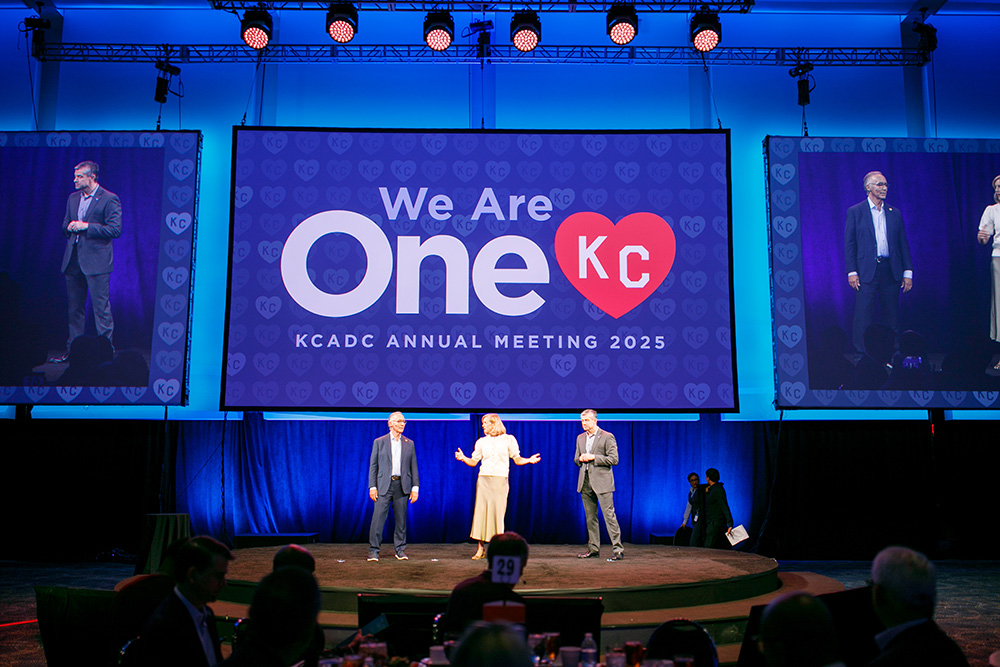
2025 KCADC Annual Meeting Highlights OneKC, Celebrating Region’s Collaboration and Welcoming the World

The sold-out event united more than 2,000 civic and business leaders who support Kansas City’s regional growth and rising global influence

KANSAS CITY – Oct. 30, 2025 – Today, the Kansas City Area Development Council (KCADC) hosted its 2025 Annual Meeting, the KC region’s largest yearly business gathering, convening leaders from across the 18-county, two-state area. 

The event’s theme, “We Are OneKC,” emphasized the message of regional unity, positioning the two states and 50+ communities in the greater Kansas City metro as a single, integrated economic region to drive collective success.

In 2025, KCADC and its partners attracted global companies to the region, driving $1.3 billion in capital investment, 3,197 net new jobs and nearly $275 million in wages. The KC region has attracted headliner companies in fintech, animal health and receives continued investment in major tech and data center projects. 

A major 2025 investment highlight came from Fiserv, a global leader in payments and financial services technology. Fiserv continues to build deeper connections across the  Kansas City region following their plans to establish a new strategic fintech hub in Overland Park, Kansas, bringing 2,000 new jobs and $175 million in capital investment.

“Fiserv is thrilled to join a collaborative and innovative community of professionals in the Kansas City region,” said Joanne Sebby, Chief Risk Officer for Fiserv. “As we evaluated locations across the country, the Kansas City region stood out for its strong spirit of partnership, depth of talent and rising growth. This is the perfect launchpad for our next chapter of fintech innovation.”

The event also spotlighted the region’s leadership in animal health, celebrating Merck Animal Health’s decision to invest $895 million in the Kansas City region earlier this year.

“Merck Animal Health’s decision is a powerful reflection of what we achieve when we work together as OneKC,” said Rob Bratcher, president of Commerce Bank and KCADC senior board co-chair. “It reinforces the Kansas City region’s position as the global leader in animal health innovation — and showcases the strength of a region that collaborates, competes and wins together.”

Best-selling author and co-producer on the Emmy-nominated show “The Bear,” Will Guidara, keynoted the event, inspiring KC’s business and civic leaders to think bigger — embracing radical generosity, intentionality and the unexpected. His message was a timely and critical one as KC prepares to welcome the world for the FIFA World Cup 26™.

Reflecting on a year marked by significant achievements, Tim Cowden, president & CEO of KCADC, encouraged attendees to embrace our singularity as OneKC.

“Kansas City’s success has always been rooted in our ability to work as one region, all aligning around a shared vision for growth,” said Cowden. “This unified approach has built a market that’s robust and resilient, increasingly recognized on a global stage. Together, we’ve positioned KC as a place where innovation thrives, businesses grow and collaboration drives results. KC is rising; the world is taking notice.”

The Kansas City Area Development Council (KCADC) is the region’s leading economic development organization, representing 18 counties across Kansas and Missouri. Consistently ranked as a top regional economic development group, KCADC drives business investment and talent attraction to strengthen the KC region’s global competitiveness.


About the Kansas City Area Development Council (KCADC)
Serving the 18-county, two-state Kansas City area, the Kansas City Area Development Council is an economic development nonprofit that promotes the region’s business and lifestyle assets to companies and talent around the world. Working closely with its two states and 50-plus county and community partners, the region has attracted more than 64,000 new jobs over its 45-year history. KCADC also leads the efforts behind the KC Animal Health Corridor, KC SmartPort, TeamKC, KC Global Design and KC Heartland. | onekc.org

Trailblazing Leaders Join KC Animal Health Corridor Board Amid Landmark Year for the Region’s Industry

New board members from Boehringer Ingelheim, Dechra and Elanco bring deep expertise, bold vision to region’s animal health cluster

KANSAS CITY, Mo. – June 11, 2025 – The KC Animal Health Corridor has announced three new additions to its board of directors: Fiona Rey, Elanco Animal Health; Dr. Fatou Sow, Boehringer Ingelheim; and Dr. Jill Stohs, Dechra. Their appointments were formalized during the Corridor’s June 9 board meeting and come at a pivotal moment of momentum for the region’s globally-recognized animal health industry.

With deep industry experience and forward-thinking leadership, the new board members reflect the strength and diversity of the Corridor’s influence — a collective representing the world’s largest concentration of animal health companies.

Fiona Rey, executive director of U.S. customer experience: revenue growth management | launch and marketing ops at Elanco Animal Health, is known for transforming business operations and launching breakthrough products that shape the future of animal health. Since joining Elanco in 2018, Rey has led global product launches, revived critical business units and introduced first-in-class treatments to market.

Dr. Fatou Sow, head of U.S. global innovation & immunology research at Boehringer Ingelheim, brings more than 15 years of experience leading R&D, manufacturing and global partnerships across the animal health industry, driving strategy focused on immune-mediated diseases in companion animals. Sow has held leadership roles at Novartis, Elanco and Boehringer Ingelheim Veterinary Medicine Belgium, and actively supports the development of scientists and emerging industry leaders.

Dr. Jill Stohs, senior director of veterinary professional services & medical affairs at Dechra, brings a career rooted in hands-on veterinary care, technical expertise and medical education. Trained at the University of Missouri’s College of Veterinary Medicine, Stohs now leads a team of more than 40 veterinary professionals across the country. She is a passionate advocate for elevating veterinary science through education, mentorship and service.

“The new additions to our board are bold, strategic thinkers who exemplify the kind of leadership that’s driving the next era of animal health,” said Kimberly Young, president of the KC Animal Health Corridor. “Their perspectives will help ensure the KC Animal Health Corridor remains not just the industry’s largest cluster, but its most dynamic and future-ready.”

The addition of new board leadership comes amid a milestone year for the Corridor, marked by major announcements from global leaders in animal health. Australia-based Ceres Tag selected the KC region for its North American headquarters in January, citing the Corridor’s strength as a hub for innovation. In May, Merck Animal Health announced a nearly $900 million expansion of its De Soto, Kansas, campus — further cementing the region’s role as a driver of global animal health.


About the KC Animal Health Corridor

Representing more than half of the global animal health industry’s sales and home to over 300 animal health companies, the KC Animal Health Corridor is the largest concentration of its kind worldwide. Anchored by Manhattan, Kansas, and Columbia, Missouri, the Corridor serves as a thriving hub for innovation and collaboration. | kcanimalhealth.com

Merck Animal Health Expands Operations with $895 Million Investment in De Soto, Kansas

Expansion further establishes KC region as global leader in animal health

DE SOTO, Kan. – May 8, 2025 – Merck Animal Health, a leading biopharmaceutical company, today announced plans to invest $895 million in the expansion of its biologics facility in De Soto, Kansas.

One of the most significant economic development projects in Kansas history and the largest to date for Merck Animal Health, the 200,000-square-foot expansion includes an $860 million investment in the site’s existing manufacturing facility and a $35 million investment in its research and development laboratories.

The project reinforces the Kansas City region’s position as the center of the global animal health industry, building on its long-standing network strength and strategic advantages in innovation.

“Our De Soto manufacturing facility is strategically located in the heart of the Animal Health Corridor. This region is renowned for its concentration of animal health companies, fostering an unparalleled ecosystem for innovation, collaboration and industry leadership,” said Richard DeLuca, president of Merck Animal Health. “This investment in our site is designed to increase Merck Animal Health’s ability to meet the growing customer demand for its portfolio of animal biologics products and ensure the company remains at the forefront of innovation in the animal health sector. This initiative also reflects our dedication to advancing animal health and our on-going investment in the communities where we operate.”

Site preparation and facility design will begin immediately, with 2,500 construction jobs expected to support site development. The expansion will create more than 200 new full-time roles when manufacturing operations begin in 2030.

“This extraordinary investment by Merck Animal Health underscores my administration’s commitment to securing a strong economic future for our state and ensuring prosperity for generations to come,” Governor Laura Kelly said. “Public-private partnerships that lead to major global projects, such as those with Merck, Fiserv and Panasonic — just to name a few recent successes — are occurring because people believe in Kansas. They believe in who we are, what we are doing and the direction we have taken.”

The new manufacturing facility will expand filling and freeze dryer capacity for large-molecule vaccines and biologic products for Merck Animal Health. As a designated Center of Excellence, it will play a key role in Merck Animal Health’s global manufacturing network while building on its decades-long legacy in the region.

“Merck has been a valued part of the De Soto community for over 20 years, and this $895 million expansion is a remarkable vote of confidence in our city’s future. We’re proud that Merck has chosen to grow right here at home — bringing 200 new jobs to our community and further strengthening a facility that has already played such an important role in our local economy,” said De Soto Mayor Rick Walker. “This is a true success story: we’ve not only retained a major employer, but we’ve helped create the conditions for their continued growth. It’s exactly the kind of outcome we work toward—keeping and expanding the businesses that make De Soto a great place to live, work and raise a family.”

Merck’s De Soto campus is strategically located within the KC Animal Health Corridor — the world’s largest concentration of animal health companies, home to more than 300 businesses representing 56% of global animal health, diagnostics and pet food sales.

“This announcement reaffirms what we’ve long known — the Animal Health Corridor is where global leaders come to grow,” said Kimberly Young, president of the KC Animal Health Corridor. “Merck Animal Health’s expansion in De Soto is more than a vote of confidence — it’s a signal to the world that this region is built for ambitious, industry-defining work.”

The project includes a major expansion of Merck’s research and development laboratories, further strengthening the company’s global leadership in parasiticide and therapeutics development, and deepening its roots in the De Soto community.

“Merck has been not only a great corporate citizen, but an integral economic engine in De Soto for the past 25 years. We are so pleased Merck has chosen to reinvest in our community and are committed to doing so well into the future,” said Tim Holverson, president of the De Soto Kansas Chamber of Commerce & EDC. “De Soto has shown they can deliver the workforce talent and values the economic partnership that has made this a true economic development success story.”

Media assets including photos, video and additional details are available in the Merck Animal Health media library.


About Merck Animal Health

At Merck, known as MSD outside of the United States and Canada, we are unified around our purpose: We use the power of leading-edge science to save and improve lives around the world. For more than a century, we’ve been at the forefront of research, bringing forward medicines, vaccines and innovative health solutions for the world’s most challenging diseases. Merck Animal Health, a division of Merck & Co., Inc., Rahway, N.J., USA, is the global animal health business of Merck. Through its commitment to The Science of Healthier Animals®, Merck Animal Health offers veterinarians, farmers, producers, pet owners and governments one of the widest ranges of veterinary pharmaceuticals, vaccines and health management solutions and services as well as an extensive suite of connected technology that includes identification, traceability and monitoring products. Merck Animal Health is dedicated to preserving and improving the health, well-being and performance of animals and the people who care for them. It invests extensively in dynamic and comprehensive R&D resources and a modern, global supply chain. Merck Animal Health is present in more than 50 countries, while its products are available in some 150 markets. For more information, visit www.merck-animal-health.com and connect with us on LinkedIn, Facebook, X (formerly Twitter) and Instagram.

About the KC Animal Health Corridor

Representing more than half of the global animal health industry’s sales, and home to over 300 animal health companies, the KC Animal Health Corridor is the largest concentration of its kind worldwide. Anchored by Manhattan, Kansas, and Columbia, Missouri, the Corridor serves as a thriving hub for innovation and collaboration. | kcanimalhealth.com

About the Kansas City Area Development Council (KCADC)

Serving the 18-county, two-state Kansas City area, the Kansas City Area Development Council is an economic development nonprofit that promotes the region’s business and lifestyle assets to companies and talent around the world. Working closely with its two states, and 50-plus county and community partners, the region has attracted more than 64,000 new jobs over its 45-year history. KCADC also leads the efforts behind the KC Animal Health Corridor, KC SmartPort, TeamKC, KC Heartland and KC Global Design. | onekc.com